Crying kink: dacryphilia, tears, arousal, and consent
Have you ever been mid-scene, mid-fuck, and watched your partner's eyes fill, then felt heat instead of panic? Maybe your body got there before your conscience did. Maybe it shamed you a little.
First: that reaction does not make you broken, and it does not make you a monster. It may be dacryphilia: sexual or erotic arousal from tears, crying, or sobbing. A "crying kink", to put it plainly.
I've written before about enjoying my submissives' tears. That moment when someone breaks down and cries during a scene, the raw surrender of it, the visible proof that they've gone somewhere deep for me, is one of the most intensely arousing things I experience as a Dominant. I know this kink from inside the room, not from a glossary. It can be safe. It can be consensual. It can be tender and filthy in the same breath. But only when people actually talk before they play.
What Is a Crying Kink?
A crying kink means tears get erotic for you. Maybe it is the sight of someone crying, the sound of a sob catching in their throat, or the feeling of crying yourself during sex or a scene. The formal term is dacryphilia (sometimes spelled dacrylagnia), from the Greek dakrya (tears) and philia (love), literally, a love of tears. The psychologist Mark Griffiths has written a beginner's guide to dacryphilia.
Dacryphilia is not one button. Some people are taken by the picture: wet lashes, flushed cheeks, a lip starting to go. Others hear it first: gasps, whimpers, sobs that make pain and pleasure hard to separate. Some are turned on by their own tears too. That can be confusing. Recent work on sexual "emotional drive" makes room for the mess: attraction and aversion can sit around the same sexual stimulus without the response being fake or automatically pathological.
Here's the thing that outsiders often get wrong: a crying kink doesn't automatically mean cruelty. I know, I know, on the surface, "I get turned on when people cry" sounds awful. But the full picture is far more nuanced than that. While some dacryphiles lean sadistic (guilty as charged: a dominant partner relishing that they brought their sub to tears), others come at it from a completely compassionate angle, aroused by the deep trust involved when someone cries in their presence, or by the act of comforting them. And sometimes tears are simply a byproduct of intense pleasure or overwhelming emotion, not deliberately caused by pain at all, yet they heighten everything.
Dacryphilia Meaning: Tears, Sobbing, Sound, and Emotional Release
So what actually counts? "Crying" is not one tidy category. It can be sound, face, breath, surrender, relief, mess. People latch onto different bits:
-
Visual: The sight of tears rolling down a face, reddened eyes, a quivering chin. I'll be honest, there's something about watching a strong person crumble, watching their composure dissolve and their face become this raw, unfiltered thing. A small study of dacryphiles, just eight people across four countries, noted that even the way a person's lips curl or tremble during a sob registered as a turn-on. The physicality of crying, flushed skin, heaving chest, damp eyelashes, becomes erotic imagery. Beautiful, in its way.
-
Auditory: The sounds of crying. Soft whimpers, heavy breaths, moans that blur into sobs. In the same way a lover's moan can be arousing, so can a lover's crying voice, especially if you know those sounds are coming from a place of consensual intensity. It's raw audio erotica. I've heard submissives make sounds during a scene that sit somewhere between a sob and a moan and I still think about those sounds.
-
Emotional: Crying is a release. It signals that someone is feeling something so strong it overflows, and that emotional intensity itself can be arousing. The intimacy of witnessing someone's vulnerability: seeing a side of them few people get to see. The trust: they feel safe enough with you to fall apart. Arousal isn't just about friction and nerve endings. Sometimes it's about being let in.
-
Physical Release: Some people intentionally cry as a form of release during sex or kink. Think about how crying often leaves you feeling lighter, even giddy, afterwards. For certain people, especially in BDSM, crying functions like a parallel to orgasm: a way to release everything that's been pent up. A submissive might enjoy being brought to tears because after those tears fall, they feel clear and euphoric. A masochist might relish the moment of surrender when tears come; it marks that they've given their all. Their own crying is erotic because it's intertwined with what they're receiving and what they're giving up.
Dacryphilia sits on a spectrum. On one end, you might simply think "My partner looks so beautiful when they cry. I can't explain it." On the other, you might specifically fantasise about making someone cry, or being made to cry, as part of sex. Both count. Some people even get turned on by fictional crying, honestly, I've felt that pull during an emotional film scene and thought, well, that's interesting.
Is It About Your Own Crying, Someone Else Crying, or Both?
A common question: whose tears are doing it for you? For some people it is their own. For others it is a partner's. Plenty of people want both.
-
Arousal from someone else's tears: Many dacryphiles are primarily turned on by watching another person cry. This is where I sit, personally. In my dominant role, there's something immensely satisfying about bringing a submissive to tears, reading those tears as total surrender. Their emotion reaches me; that is part of why it works. That's the point. One person described loving the "moment a tear forms and falls," comparing it to the visual of climax. I understand that completely.
-
Arousal from your own tears: Yes, some people are turned on by the experience of crying themselves. This often goes hand-in-hand with masochism or emotional release. The idea of letting go completely, of being reduced to tears, can be the ultimate submission. Or it can simply be that crying during orgasm or intense stimulation makes the whole experience more powerful, an additional physiological release layered on top of everything else. In kink circles this is sometimes called "catharsis play": deliberately using a scene to reach cathartic emotional release. BDSM educator Mollena Williams-Haas has spoken about how some submissives crave a good cry as part of a scene, much like others crave physical marks; it's evidence of having gone to the edge and back.
-
Both directions: It's entirely possible to be aroused by both your own crying and your partner's. Think of a power exchange couple deeply attuned to each other: the dom enjoys that their sub is crying, the sub enjoys being in tears; each feeding the other's arousal. It all loops together.
If your partner tells you they have a crying kink, don't nod vaguely and hope you understood. Ask: "Do you mean me crying, you crying, or both? What are you actually picturing?" That answer decides the scene.
Why Tears Can Be Arousing
When crying turns erotic, the charge can be embarrassingly direct: someone is exposed, and you are close enough to see it.
-
Intense Emotion and Vulnerability: Sexual tension often lives right next to emotional risk. Few things are as vulnerable as crying. Seeing a partner cry can be powerfully intimate; you're witnessing something raw and true. For some, that depth of authenticity is a massive turn-on. You're not just seeing their body, you're seeing them. And I think that's why, in BDSM particularly, tears carry such erotic weight, because power exchange is already about emotional depth. Tears are just the visible evidence.
-
Compassion and the Urge to Comfort: A significant number of people with a crying fetish report that their arousal comes from empathy and compassion, not cruelty. A 2015 survey found that about half of participants (notably, all women in that group) said they were turned on by comforting someone who was crying. Being the shoulder to cry on can make a person feel needed (really, properly needed), and that feeling can tip straight into arousal. It's a protector fantasy: I'm the one who makes it better. I understand this even from my sadistic angle, after I've brought a sub to tears, the aftercare, the holding, the "I've got you"; that part is arousing too. The cruelty and the comfort are both part of it.
-
Power and Control: On the other end, tears can be arousing because they symbolise power dynamics. In BDSM, making someone cry, or being made to cry, can be the most visceral proof of power exchange there is. A dominant might think, "I'm powerful enough to move you to tears", fuelling their dominant ego in a consensual way. A submissive might relish the feeling of "They've conquered me so thoroughly I'm crying", a peak submission moment. The key is consent and a container: the partners agree that tears are allowed, even desired. Within that, crying stops being something negative and becomes something charged and wanted. For me, tears are the moment the power stops being theoretical.
-
Subverting Gender Norms: Society tells us "boys don't cry." Seeing a typically stoic person let go can be thrilling: access to a secret side of them. Some heterosexual women report that seeing a man cry is particularly arousing, precisely because men are socially discouraged from it. That does not surprise me. The pressure on men to be stoic, to be the "alpha" who never shows emotion; when that facade cracks during a scene, when a man actually cries for you? It's incredibly powerful. You're seeing something he won't show anyone else. Interestingly, one study noted that men's arousal often drops when smelling actual tears from women, due to biological empathy responses, which makes the consensual fantasy context all the more important in distinguishing dacryphilia from everyday emotional responses.
-
Aesthetic and Sensory Arousal: Sometimes it is not deep psychology at all. Wet eyelashes. Salt on a kiss. A chest hitching on the inhale. Tears are bodily and messy. So is sex. A lover's tear-wet face can hit the same switch as sweat, spit, flushed skin, bitten lips.
-
Catharsis and the "Breaking Point": Some kinksters are drawn to the idea of pushing limits, not in a consent-violating way, but in a "how much can we feel?" way. Crying represents that breaking point. Reaching it and coming back safely can be an incredible rush. A bottom might crave that crescendo: "I want to cry, because that's how I know I really went deep and gave my all." Tears become the visible marker that "we went there." Dossie Easton and Janet Hardy's The New Bottoming Book is good on this: scenes that crack open a big emotional release, then settle into profound intimacy and an almost spiritual afterglow. Cry-gasms are a thing: not literal orgasms from crying alone, but a tension-and-release cycle that some find equally satisfying.
-
Taboo and Transgression: Finally, mixing crying with eroticism is taboo, the same charge that powers exploring taboo fantasies in submission. We get taught that sex means pleasure and tears mean something has gone wrong. Put them together and the forbidden feeling switches on. And forbidden = exciting to the human brain. When I first read The Erotic Mind by Jack Morin, I was struck by how cleanly he articulates this: "violating prohibitions can provide avenues for self-assertion and affirmation"; further, fantasy requires us to "forget and remember at the same time" the taboo we're transgressing, because if we lose sight of it entirely, the charge evaporates. That's exactly what's happening with a crying kink: the transgression of mixing tears with desire is precisely what powers the erotic current. If you've been told your whole life that crying is "weak" or "pathetic," weaving it into sex might reclaim it as something powerful. That psychological flip is a hell of a thing.
Visual Triggers: Tears, Sobbing, Facial Expressions, and Curled Lips
Greenhill and Griffiths found the curled lip, that facial change appearing right before someone starts to cry, was one of three recurring turn-ons people named, alongside compassion and dominance/submission. You know the expression: chin wrinkling, lower lip pushing forward, breath catching, the tiny warning before composure gives way. For some people, that visual cue is more potent than the story behind the tears.
This matters when you negotiate. If what turns you on is the visual or auditory trigger, say that. You may not need humiliation, pain, or a heavy emotional scene. You may need theatrical crying, an emotional film, roleplay, or a partner who likes letting that expression show. The more specific you can be, the less likely you are to accidentally ask for the wrong kind of intensity.
Compassion, Comfort, and Feeling Needed
There is a softer version of dacryphilia I think of as the "comfort kink": arousal through nurturing, being trusted, being needed while someone cries. If "being sweet and caring" doesn't sound kinky to you, fine. Bodies are weird. For some people, tenderness is the switch.
Maybe your partner has had a wretched day and starts crying while you're already close. You hold them, stroke their hair, whisper "I've got you." They sob into your chest. You feel a swell of protectiveness, love, and yes, desire. The arousal comes from being trusted with the mess. The tears are not an interruption. They are now part of the moment.
People who identify with this side often say things like: "Seeing my partner cry makes me want to hold them so tight, and that closeness turns me on," or "Being allowed into that intimate, vulnerable space is what does it for me." The charge is care, not injury.
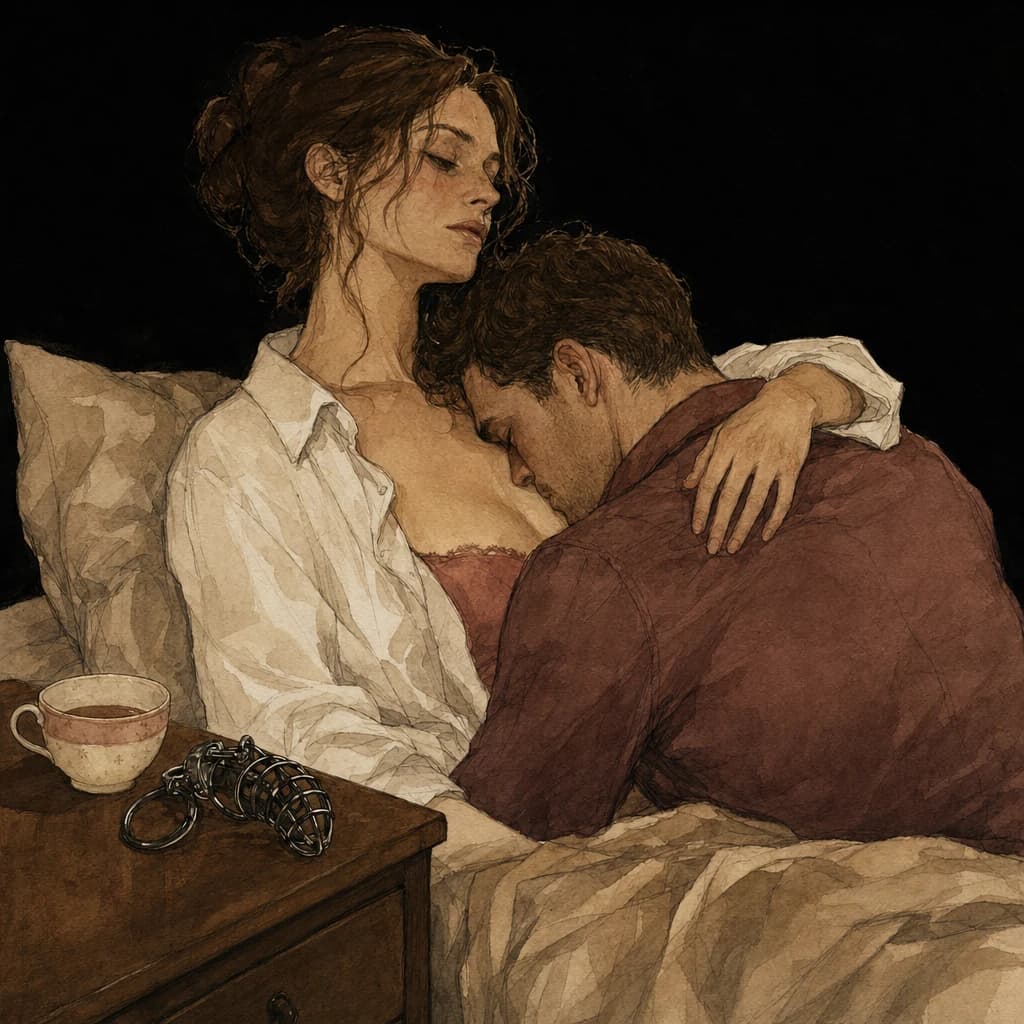
A few examples of how this plays out:
-
Tears of Joy: Your partner cries from relief or overwhelming pleasure, perhaps after an intense orgasm. Your response is to almost reverently continue, cherishing their tears as proof of how powerful the moment is. It's not about pain at all; it's pure positive emotion amplified.
-
Supporting Through Pain: Maybe a partner wants to explore a difficult emotion with you. They might ask to be held while they cry, and see if it becomes sensual. It takes enormous trust and good communication, but for some couples, this can be healing and hot simultaneously. (Careful here: this can drift toward therapy very quickly. Heavy trauma in a sexual context is not something everyone can hold, and no one owes a partner therapist-work because it turns them on. Know your limits.)
-
Crying as Foreplay: Think roleplay scenarios where tears break down a wall and lead into sex. A reunion scene, a comfort scenario, the kind of thing you'd read in erotica, where someone's tears are what tips the moment from emotional to sexual.
In all these cases, the tears open up a tenderness that tips into something sexual. "I'm aroused because I care this much" is a very different thought from "I want to hurt you."
Caveat: This only works when you have talked about it. If your partner is in genuine, non-roleplay distress, grieving, angry at you, or processing trauma, don't make it sexual. Both people have to want the crying in the room. Say it before the scene: "If I cry, keep going unless I signal stop" or "If I cry, pause and check in." Tears are not permission unless you both made them part of the deal.
When this works, it can leave both people feeling properly seen. Being wanted when you're blotchy, wet-faced, shaking, and not performing prettiness has its own voltage.
Power Exchange, Sadism, and Consensual Tears in BDSM
Now let's talk about the other side: the dark, spicy, power-play side. My side, if I'm being transparent. The arousal from causing or witnessing tears as part of dominance and submission. This is the bit that can sound twisted to the uninitiated, so I'll say it plainly: in consensual kink, twisted can be absolutely delicious for those who enjoy it. Research on Dominant-identified kinksters backs up that this role is rarely just "I like hurting people"; participants described control and power exchange alongside connection, fulfillment, consent, learning, and caregiving.
In BDSM, tears can be the ultimate fetish accessory. I think of a submissive's tears as a gift: "They're crying for me. I've taken them so deep that they're sobbing; that's my power, my connection with them, my responsibility." Meanwhile, the submissive who craves it might be internally saying: "I'm crying for them. I'm giving everything. I'm laying myself completely bare." And it is always consensual, followed up by aftercare; I've been thanked on every occasion for fulfilling their need to reach that depth.
Here's how this plays out:
- Physical Sadomasochism Leading to Tears: Sometimes it's straightforward, the play is intense enough physically that the bottom cries. Heavy impact play (a hard caning, for instance) might eventually produce tears even when the sub is enjoying the pain. A masochist might treasure those tears as a milestone: "I took so much it made me cry", and the sadist might be deeply turned on by that wet evidence of their impact. They might even negotiate it as the scene's goal: "I'm going to spank you until you cry." It's edgy, it requires enormous trust, and it might need an immediate shift into gentle aftercare once achieved. But for those who desire it, it's an incredible rush. If you're aiming for tears via pain, you must have very clear safewords and understand that every body is different; some subs ugly-cry yet are 100% fine to continue; others shed one tear and are genuinely at their limit. Tops need to be attentive and communicating throughout.
That "until you're sobbing" fantasy is not imaginary niche noise, but it is not universal either. In BeMoreKinky's own interest data, a sizeable minority were into hearing a caning threat framed around being left sobbing, while the majority still said no; the dominant-side interest in saying it was smaller again. That is the real shape of dacryphilia-adjacent sadomasochism: present, potent, and absolutely not something to casually assume.
-
Emotional Sadism and Tears: It's not always physical. Emotional domination or erotic humiliation can produce tears too. Think roleplay: a strict Mistress berating their slave, an interrogation scene where the interrogator makes the prisoner weep, a "punishment" scenario played out until the sub sobs. These are consensual mind-fucks that often climax with tears. The tears add realism and intensity, if you're roleplaying punishment, crying makes it feel convincingly real, which heightens arousal for both. This is advanced territory. It requires front-loaded consent: both partners agree on the scenario, the limits of what can be said, and crucially, that a safeword or signal exists to stop everything if it stops being fun. BDSM educators like Midori and Jay Wiseman emphasise that negotiation is critical: you plan these scenes almost like theatre, so that when tears flow, they're within the bounds of what was agreed.
-
Voyeuristic Enjoyment: Some dominants enjoy watching someone cry without necessarily being the direct cause. A dom might tell a sub to cry for them, as a display of obedience, as a form of emotional vulnerability on command. It's about the look of someone laid bare, and the power of being the one watching.
-
Tears as Part of D/s Ritual: In some intense D/s relationships, a sub's tears become something almost sacred: a symbol of how deep the submission goes. The Dom holds the weeping sub, proud of guiding them to that zone. It feeds the dynamic in a strange, poetic way: the sub is in tears but also in bliss from serving; the Dom is tender or stoic, but definitively in control. Mollena Williams has pointed out that exploring such depths requires the dominant to be as responsible and caring as they are strict; you don't break your people, you polish them. (I love that framing.)
When playing with the power/sadism side of a crying kink, aftercare is absolutely non-negotiable. No matter how nasty or cold a dominant acts during the scene to elicit those tears, once the game is over, you switch to compassionate mode and ensure your partner is okay. I find this transition, from cruel to caring, one of the most fulfilling parts. The bottom, having been so vulnerable, needs reassurance that they're safe, loved, and that the scenario was exactly that: a scenario. This is not just community lore; recent aftercare research frames care after intense kink as a negotiated, responsive process shaped by the scene, the people, and what each body needs to come back down.
Jay Wiseman, whose SM 101 is one of the older introductions to all this, has noted that intense emotional scenes often require more skill and empathy from the top than even heavy physical scenes, because the psychological fallout can be complex. Part of the skill is monitoring and knowing when tears are the good kind, cathartic, desired, versus the bad kind, where someone has actually crossed beyond their limits. This is why you can't skip the communication part, ever.
One more note on humiliation play, since it's a common catalyst for tears. With humiliation, real tears can arrive because the pretend insult lands in the body for a second. That can be the charge, but it is also the risk: hit the wrong insecurity and you do not get hot surrender, you get damage. Have a clear debrief afterwards, remind the person that what was said was roleplay, and establish forbidden topics in advance (real family issues, genuine insecurities that aren't fair game, etc.). I cannot stress this enough; the negotiation beforehand is what makes or breaks this kind of play.
Many describe an almost euphoric state afterwards: the sub feels cleansed, owned, loved; the dom feels powerful and close to their sub in a way that's hard to get any other way. And for some of us, that is the turn-on.
When Crying Is the Focus vs. a Byproduct of Play
Whether crying is going to be the focus of your play or a byproduct shapes your approach.
Sometimes the tears are the plan from the beginning. A couple might say, "Tonight, let's do a scene where you make me cry," or "I want to see your tears, let's figure out how." Then you do the unsexy bit: tissues nearby, safewords fresh, and a blunt conversation about what kind of crying you mean. It is just choosing a focus for the night, except the focus is tears.
Other times, crying is a byproduct of something that wasn't specifically about tears. Maybe you're mid-scene and suddenly one of you starts crying, from overwhelming pleasure, from a painful strike that unexpectedly unlocked something, from sheer emotion. These tears are unplanned but not unwelcome. Many people discover they have a crying kink because of exactly these spontaneous moments: someone cries during a scene, both partners find it strangely beautiful, and later there's a "Huh… maybe we like this?" conversation. I think that is probably the most ordinary route in.
The distinction matters because consent works differently.
If crying is the focus, you negotiate it before play starts: what you want, how you might get there, and what happens if it becomes too much.
If crying is a byproduct, it may catch you both sideways. Consent has to be checked in the moment: a breathy "You alright?" while still in flow. If they smile and nod through tears or moan "Don't stop", the tears may be adding to it. If they go quiet or look away, pause. This is why it helps to have the boring conversation earlier: "If one of us cries, let's check in. It doesn't automatically mean stop, but we ask."
A BDSM habit helps here: use a check-in that does not flatten the mood. The traffic light system works beautifully here. "Green" means everything's fine, tears notwithstanding. "Yellow" means slow down. "Red" means stop. These can be uttered softly without breaking flow. If you haven't set that up, a simple "Do we need to stop?" works too. Don't assume a tear is an automatic stop sign; some people really want to continue, but don't assume it's kinky heaven either. When in doubt, ask gently.
One more nuance: you can't always control tears. They either happen or they don't. Pressure to cry can actually make someone shut down. Keep expectations realistic and be clear that if tears don't come, that's absolutely fine, no performance required.
Consent Comes Before Any Crying Scene
Consent is especially critical here because in everyday life, tears usually signal "Stop, I'm not okay." To integrate crying into a sexual or kinky context, you and your partner need to consciously override the usual meaning of tears, and that requires explicit, clear discussion. The standard BDSM safety frameworks apply, but this kink adds one layer the general guides don't cover: you have to explicitly agree to not treat tears as a stop signal.
Here's how that plays out in practice:
1. Boundaries and Triggers First. Talk before anything starts. A yes/no/maybe boundaries list helps here. Name the routes you are willing to take, pain, humiliation, emotional roleplay, and the ones you are not. Be specific: "You can make me cry via impact play, but don't bring up my ex; that will genuinely hurt me in a bad way." Say where the walls are.
2. Emphasise Mutual Consent. Never try to make someone cry erotically without their knowledge and agreement. If you think your partner might be into comforting you if you cry but you're not sure, ask. A simple "How would you feel if I got emotional during sex?" opens the door.
3. Make Consent Explicit for Non-Standard Behaviours. Say it in plain, almost boring language: "If you cry, I won't automatically stop. I will stop if you use the safeword." It may feel formal. Say it anyway. That awkward sentence is what lets the scene breathe.
4. Consent to Aftercare Needs. Agree on what happens after. If someone consents to a humiliation scene that ends in tears, they might say: "Afterwards, I need you to immediately drop character, hold me, use my name, tell me kind things." The top should agree to provide that, and mean it.
5. Reconfirm Over Time. Consent isn't a one-and-done, especially with intense play. Check in: "Still into it? Anything you'd change?" People's limits shift.
Never use a crying kink as an excuse to actually harm or manipulate someone. If someone is truly upset and saying no, you stop, fetish or not. Real emotional pain is not kink-fodder by default. Full stop.
How to Talk About a Crying Kink With a Partner
Maybe you're reading this thinking, "Right, I'm into it… but how the hell do I say that out loud?" Fair. Even with an adventurous lover, "Can we bring crying into sex?" is a strange sentence to hand someone. You may worry you will sound sadistic, damaged, or weird. I get it.
1. Do It Outside the Bedroom. Bring it up in a neutral, relaxed setting, not mid-fuck. Over coffee, during a cuddle, when sharing sexy thoughts in a low-pressure way. You could reference something external: "I came across this article about unusual kinks and one was about being turned on by crying. It made me realise: I think I might have a bit of that. Have you heard of dacryphilia?" Using the actual term can help; the clinical name adds a kind of legitimacy that defuses initial shock.
2. Explain What Appeals to You. Your partner will likely ask "why?", so be ready to articulate your personal angle:
- If you're compassion-driven: "It's not that I want either of us unhappy. It's more that seeing you vulnerable, and being the one who holds you, oddly turns me on. That closeness feels sexual to me."
- If you want to be the one crying: "Sometimes I feel tears coming during sex, and I usually swallow them down. I think letting them happen might feel good, but I've been nervous about your reaction."
- If you lean dominant/sadistic: Be careful with framing. Stress the consensual, playful nature: "There's a part of me that thinks about pushing you to tears during a scene, not real harm, but as part of a kinky game. The idea of that intensity together turns me on. But only if you were curious and willing."
3. Address Their Concerns. Give them space to react. They might ask:
- "Does this mean you enjoy when I'm actually sad?" Clarify: "No. I mean play we've both agreed to, not me using your real-life sadness."
- "What if I can't cry on cue?" Answer: "Then we don't chase it. Please don't perform tears for me."
- "What if you get turned on when I cry for real?" Answer that one directly: "If you're genuinely upset, I'm looking after you first. Sex can wait. The kink is negotiated play, not me using your distress."
4. Be Patient. They might not jump for joy. They might need time. If they say no, take the no cleanly. They do not owe you this kink just because you were brave enough to say it out loud. YKINMK goes both ways.
5. Ask About Their Want Too. Do not turn the whole conversation into a pitch for your kink. Ask what has been sitting in the back of their mind. Put one card down; let them put one down too.
6. If You Might Be the One Crying: Your partner may panic. They may think they are hurting you. Spell it out: "If I cry here, that might be release. If it turns bad, I will safeword." Go slowly. Start mild. Let them see that those tears were cathartic, not devastating.
Safewords, Check-Ins, and Aftercare for Crying Kink
The full toolkit lives in our BDSM aftercare guide, but crying kink adds wrinkles worth spelling out here.
Safewords and Signals
Standard safewords take on extra weight when tears are involved. A sobbing person can look like they need rescuing while still being fully in the scene, so your signal has to be unambiguous. Don't rely on "stop" or "no" if those words are part of the script, and if speech disappears into sobbing, have a physical signal ready instead. For how to set up and run safewords, see our safewords guide.
Check-Ins During Play
A check-in lets you gauge where your partner's at without stopping everything dead. If deep in a scene, a palm scratch or held squeeze can serve the same purpose.
Aftercare
After the scene, the roles loosen and everyone has to land back in their body. With crying kink, this matters even more than usual:
- Verbal reassurance: Especially after humiliation or sadistic scenes, drop character completely and remind them they're loved, valued, safe. Use their real name. Mean it.
- For the top too: Tops can experience "top drop", guilt or unease after causing their partner to cry, even consensually. If guilt hits after, ask for a reality check. I have had that wobble too.
Keep the tissues within reach.