What Is Shamanic Kink? Ritual BDSM and Its Healing Claims Explained
I'll be honest: the first time I heard the phrase "shamanic kink," my reaction was somewhere between curiosity and wanting to roll my eyes so hard they'd need surgical retrieval. It sounds like the sort of thing you'd find on a retreat flyer wedged between cacao ceremonies and goat yoga, and if you know anything about my feelings on toxic positivity and performative wellness culture, you'll understand why my guard went up.
But then I actually looked into it. And while I'm keeping one eyebrow firmly raised at some of the more grandiose claims, no, Brenda, your flogging session is not equivalent to an ancient tribal initiation, sit down. There's something interesting here that deserves more than a dismissive snort.
Shamanic kink. Strip away the mystical branding and what you've got is this: the idea that the tools of BDSM, power exchange, intense sensation, role-play, the lot, can be used with deliberate, ritual intent for emotional release, personal change, or healing. It's kink with a purpose beyond getting off. Not instead of getting off, mind you. But with an added layer of "what if this flogging session was also a rite of passage?"
Spiritual language plus vulnerable people can go bad quickly, and I'd rather name that early than pretend every candlelit room is safe.
What shamanic kink means: BDSM with ritual intent
Plainly: shamanic kink is BDSM done inside a ritual frame. It is still kink, but the scene is aimed at a specific emotional shift: grief, shame, courage, surrender, whatever the person brings in. Fetish meets the sacred. One practitioner describes it as the intentional and ceremonial use of BDSM tools, toys, and techniques within a loving, conscious framework. Which sounds lovely, if a bit like someone's trying to get funding.
The practical version is simpler: BDSM provides the tools and structure: rope, impact, power dynamics, role-play. These activities produce strong physical sensations and tap into emotionally charged dynamics like surrender, struggle, and authority. None of that is news to anyone who's spent five minutes in the scene.
The shamanic or ritual approach provides the context and intention. Instead of treating a scene as play (not that there's a single thing wrong with play), you treat it as a meaningful ritual. There might be an altar. There might be breathwork. There's often a stated intention at the start, something like "I release past shame" or "I step into my power." The scene carries that intention, then closes deliberately: a few words, a symbolic item removed, something that tells the nervous system ordinary life has resumed.
A Psychology Today piece on the subject noted that both BDSM and shamanism can involve negotiated, trance-like experiences aimed at healing or growth; a preliminary study of consensual BDSM scenes also supports the idea that these altered states can be role-specific rather than generic woo. And honestly? Anyone who's ever gone deep into subspace or topspace knows that a well-executed kink scene can feel like a trance journey, whether or not you wrap it in ritual language. I've had scenes, both as Top and with my partner, that left me altered afterwards. Not "the universe opened a portal above the St Andrew's Cross"; more like walking home weirdly quiet because something in you has moved and you do not have language for it yet. I can see why someone would want to build a scene toward that on purpose instead of hoping it appears by accident.
Author and educator Lee Harrington has written that for some, kinky activities become tools for reaching "altered states of consciousness, creating spiritual epiphanies, and changing lives", much like the deep trance work in advanced erotic hypnosis. That tracks with my experience. The endorphin rush, the connection, the intensity of holding or surrendering power; these things do change you, whether you're calling it ceremony or just calling it a bloody good scene.
What sets this approach apart: consciousness and presence (no zoning out; both parties striving to be fully, acutely there), intentionality (the scene has a purpose beyond orgasm), a ritual framework with clear beginning, middle, and end, and a guide or facilitator who functions less as a Dom-for-dominance's-sake and more as someone holding space for the bottom's journey. As sex educator Midori puts it: "Fully engaged kink insists on full presence without pretense: the willingness to connect your raw humanity to another's raw humanity." I love that. That's what good BDSM has always been about for me.
Some in this field describe the top or dominant as a sort of shaman, leading the ritual journey for the bottom's benefit. Obviously the Dom can have their own intense experience too, and in my experience, they absolutely do, but the idea is that the focus sits on purposeful change rather than ego.
What's relatively new is the conscious packaging of it as a reproducible practice: branded immersions pulling from ancient ritual, modern sexology, tantra, and good old BDSM know-how. Whether that packaging adds real value or just adds a price tag is something you'll have to judge for yourself. I have my suspicions about some of it, but I'll get to that.
How it differs from BDSM, tantra, and conscious kink
If your first thought is "isn't this just tantra with extra spanking?" you're not miles off. The overlaps are real. The boundaries between these worlds are blurrier than practitioners might like to admit, but the differences do exist.
Versus "regular" BDSM: The activities can look absolutely identical. Bondage, impact, D/s roleplay, sensation play, same toolkit. The difference is intent and context. In a regular scene, the goal might be mutual pleasure, sexual gratification, or exploring a power dynamic because it's hot. And that's brilliant. There is absolutely nothing lacking in kink that exists purely because it gets you off. But shamanic kink explicitly adds objectives like healing, self-discovery, or spiritual growth. There's more likely to be formal ritual structure and possibly some spiritual language, calling the session a "ceremony," referencing energies or archetypes. Standard BDSM is about erotic pleasure and consensual power play; shamanic kink is about erotic pleasure and deliberately cracking open the psyche.
Versus neo-tantra or sacred sexuality: Tantra workshops involve breathwork, energy work, eye gazing, talk of chakras and kundalini, all geared toward connecting sexuality with spirituality. Shamanic kink shares the "sex as sacred" premise but specifically embraces the BDSM elements that traditional tantra spaces have historically avoided: pain, restraints, power exchange, the darker edges of fantasy. If tantra is the candlelit dinner, shamanic kink is the candlelit dinner where someone might also get spanked until they cry and feel grateful for it afterwards.
Tantra tends to chase ecstasy through pleasure and energy; shamanic kink will also use challenge, pain, fear, surrender, or the charge of being controlled. If tantra workshops have ever felt too gentle, too light, too much soft eye-gazing and not enough teeth, this is probably the branch that will make more sense to your nervous system.
Versus "conscious kink" or therapeutic kink: These are very close cousins, arguably interchangeable in many cases. Both emphasise consent, negotiation, presence, and aftercare. Both involve debriefing what you learned about yourself. If anything, "shamanic kink" leans more into explicit ritual and spiritual framing: smudging, chanting, invoking archetypes, while conscious kink in a therapy-adjacent setting might skip the mystical trappings and use purely psychological frameworks. Many anecdotal reports and some research suggest that BDSM, done consensually and intentionally, can be therapeutic or cathartic for participants. Shamanic kink is basically conscious kink with added mysticism.
Here's the vibe shift in miniature:
A standard BDSM scene: You and your partner negotiate a spanking scene because you both fancy it. Safe word agreed, roles chosen: strict professor and naughty student. It's sexy and fun. You cuddle after. Everyone's satisfied. Bloody marvellous.
A shamanic kink scene: Same setup, professor and student, but you've discussed beforehand that you carry guilt about "being bad," and you want to release it. The spanking is crafted as a ritual to feel, express, and then let go of that old shame. Maybe there's an affirmation repeated during play. Maybe the shame cracks and you cry into your partner's chest because the scene finally reached the thing you named at the start. Afterwards, you close the space on purpose, talk through what happened, and give the residue somewhere to land. You might journal about it later.
Same script on the surface. Vastly different intent underneath. Neither is "better," and I want to be clear about that, because the implication that conscious kink is somehow more evolved than regular play does my head in. They're different flavours. Shamanic kink caters to those who want to mix pleasure with personal growth, and that's wonderful, but if you're having great, consensual, satisfying scenes without a single candle or stated intention, you're doing kink right too.
The Three Pillars of Shamanic Kink: Role-Play, Power Exchange, and Sensation
Three themes come up repeatedly as the core containers in this work. They're the central dimensions of any BDSM scene, but in shamanic kink they're treated as portals to the deeper parts of the self. (Yes, "portals." I know. Bear with me.)
Role-Play (Archetypal Play): When you step into a persona other than your everyday self, the authority figure, the captive, the wild animal, the High Priestess, whatever calls to you, something interesting happens. Oddly enough, the mask can let the true thing slip out. Most of us have emotions or desires we suppress because "that's not me." Role-play gives permission via the role. A person who struggles showing vulnerability might find it pouring out of them when they're "in character." Someone shy might discover they can roar with confidence when inhabiting the seductress or the stern Master.
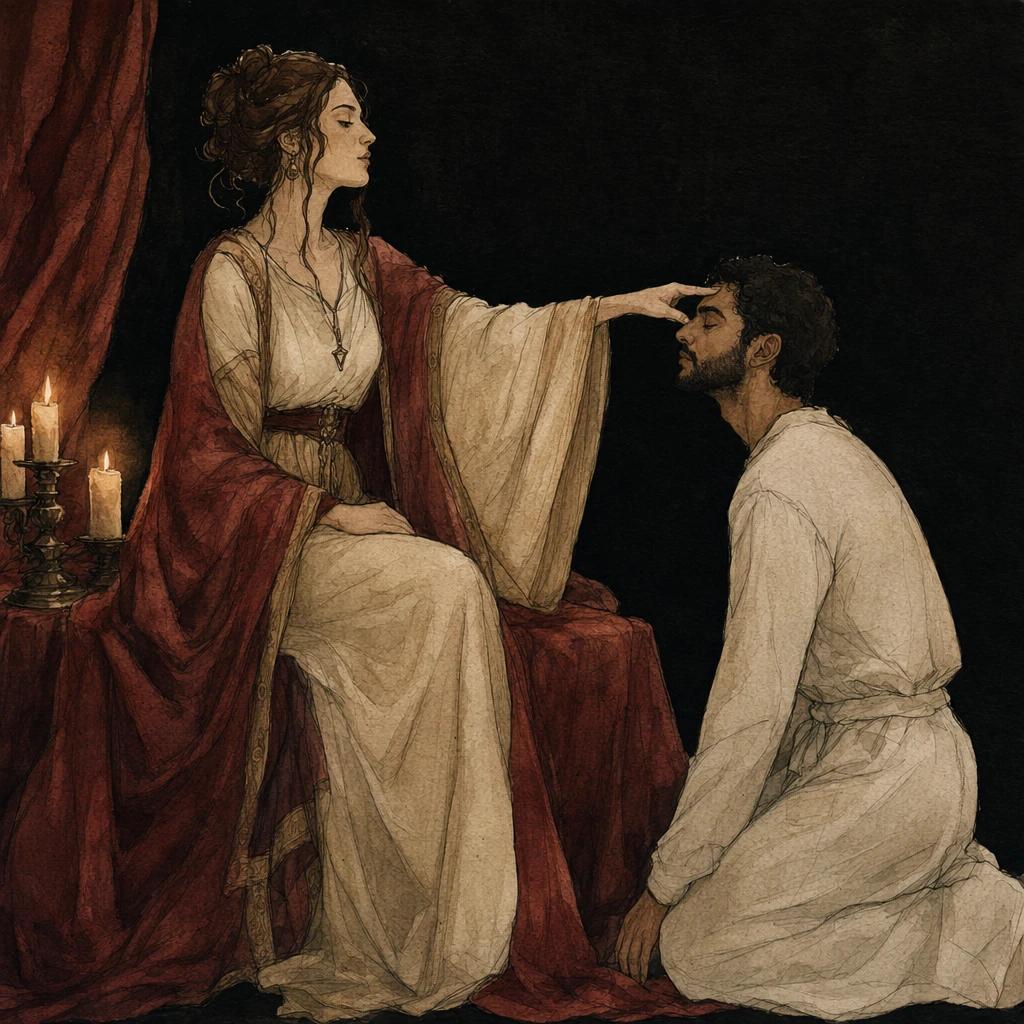
I've seen this happen. I've felt it happen. The roleplay elements of D/s are, for me, where the sparks fly; they focus everyone involved and intensify what's happening in ways that the everyday version of ourselves would resist.
Archetypes are frequently invoked because they tap into something universal: the Nurturing Mother, the Shadowy Demon, the Punishing Judge. As Easton & Hardy note, role-playing lets us indulge our love of theatre and enact parts of ourselves that otherwise stay hidden, a view reflected in discussions of kink as spiritual practice. It's a safe container to explore feelings society might forbid: the aggression, the raw innocence, the desire to submit completely. In a healing context, you might give a voice to your inner brat, comfort your inner child, or exorcise a demon of shame, all through imaginative play.
These scenes are typically negotiated in detail, with clear boundaries between role and reality. Putting on a particular collar or costume piece signals "we're in scene"; removing it means "we're back to ourselves." That separation matters. That little exit ramp lets everyone buy into the scene and then properly leave it behind.
Power exchange: In BDSM, power is not accidental; one person gives over a measure of control, and another accepts responsibility for it. In shamanic kink, that exchange gets pointed at questions of trust, surrender, agency, and what power does to us.
For the person submitting, giving up control in a safe container can be wildly freeing. It's a chance to turn off the hyper-vigilant mind and let someone else steer, which can lead to real relief, even meditative calm. Easton & Hardy describe a "meditative state" some submissives reach: a quiet serenity from the selflessness of submission, whether blank-slate receptivity or active service, both turning off self-focus and inner chatter. I've watched it happen. That moment when a submissive actually lets go, stops fighting the vulnerability and just drops, is one of the most arresting things I've experienced in BDSM.
For the person dominating, holding power responsibly invites them into leadership as care rather than ego trip. Many Doms in these contexts describe feeling a sense of service to the submissive and the process, a bit of a reversal where they're serving the scene's intention as much as the sub is serving them. That rings true for me. Good D/s has always been mutual, and I think the best Dominants understand their role as one of huge responsibility and care, even when, especially when, they're being utterly, deliciously cruel. It's almost like (shock!) I don't just blanket-apply my dominance but take the time to find out exactly what turns each person on, what their desires are, how they'll find maximum fulfilment. The shamanic kink framework just makes that unspoken understanding explicit.
Used carefully, power exchange can give a person a new ending to an old body-memory. Someone who once had no choice might choose surrender this time, be listened to throughout, and come out with their agency intact. Or by playing the dominant role and discovering that strength within themselves. It's almost Jungian: integrating dark and light aspects by consciously playing with power rather than denying it, the same shadow-work logic behind existential kink.
Sensation (Pain and Pleasure as Transformative Tools): BDSM sensation can be blunt and immediate: the bite of a whip, rope biting into skin, the head-rush of being held down and allowed to stop thinking. For some of us that is hot; it can also tilt consciousness sideways. This is why so many rituals have involved the body doing hard things: fasting, sweat lodges, walking on coals, getting tattooed during ceremonies. They're using physical intensity to transcend the ordinary mind.
In BDSM, pain and intense stimulation release endorphins that produce the euphoric high we call subspace. In a shamanic context, that endorphin high is comparable to a trance state. Not everyone experiences pain as pleasurable, and shamanic kink doesn't require heavy pain; it's really about sensation in a broad sense, calibrated to what the person can handle and wants. The idea is that strong sensations keep you rooted in your body, present, and can unlock catharsis that thinking and talking alone sometimes can't reach.
Author and therapist Dossie Easton gives one example that has stayed with me: during grief over a friend's death, she chose an intense flogging scene. The pain did not create the grief; it gave the grief somewhere to come up. She cursed at her top to go harder, unleashed a primal scream of anger, then collapsed into tears. Her top held her as she cried, and they both felt something lift: a burden, gone. That gets to me. Sometimes sensation reaches the places that words can't.
By weaving all three pillars together, a shamanic kink scene can become staggeringly layered. The role-play gives psychological permission, the power dynamic gives structure and emotional context, the sensation provides the physical pathway to release. This is how kink becomes a form of "soul work": not acting things out, but working things out of your system.
You don't need to include all three every time, of course. A rope suspension might be mostly sensation with a dash of power exchange and no role-play at all, yet still feel like a kind of meditation in ropes; interviews with Japanese rope bondage practitioners have described themes of catharsis, embodiment, empowerment, communication, and community around that kind of work. An age-regression scene might be hugely healing through nurturing role-play without any pain involved whatsoever. The mix is tailored to the individuals. SM educator and body ritual practitioner Cléo Dubois puts it plainly in Spirit of Desire: "Body-based rituals are always about your inner landscape and personal myth. No two are the same." That's worth sitting with. There's no universal formula here; what cracks something open for one person might leave another cold, and a good facilitator knows that. Sex therapist Jack Morin famously noted that our hottest erotic triggers often entwine with deeper emotional patterns; by following the thread of what turns you on, you often discover what your psyche is trying to tell you. I think he was right. Being kinky isn't something separate from who you are; it's part of your personality, your nature. The things that arouse us have a habit of pointing to the things we need to look at.
Why All the Ritual? Understanding the "Sacred Container" of Shamanic Kink
People in this world love the phrases "sacred container" and "ritual space," and if you're anything like me, you may immediately want to make a small suspicious noise. Strip away the velvet language and the practical question is simple: what is the ritual doing?
Ritual does have jobs to do here, even if you never plan to call in the four directions before a flogging scene.
Safety through structure. By formally opening and closing a container, participants have a clear psychological boundary between everyday life and the scene. An opening ritual signals to your brain: it's safe to go into this special mode, regular rules are slightly suspended, new rules are in place, this is a deliberate environment for going deep. A closing ritual tells your psyche: we're done, come back now. This prevents confusing emotional bleed-through and helps people re-ground after intensity.
This isn't actually so different from the way many of us already do BDSM, when you think about it. Putting on the collar, picking up the flogger, using that specific voice; these are rituals too, even if we don't call them that. The removal of the collar, the shift back to first names, the aftercare cuddle: that's the closing ritual. Shamanic kink just makes the implicit explicit and often cranks it up a few notches.
That tracks with BeMoreKinky's first-party data too, in a very non-miraculous way. In the shamanic/ritual slice, matched ritual, symbolic, and service items landed at 75.7% yes/maybe; "Create rituals for them" reached 78.0%, and "Wear symbolic jewelry" reached 79.9%. But when people answered a love-language style question, "ritual privileges or restrictions" sat at only 7.9%, while verbal praise or correction was 56.5%. So: yes, plenty of people are drawn to ritual structure, symbolic markers, and deliberate service. No, that does not mean the room needs grand spiritual claims to make the ritual useful.
Depth and meaning. Rituals engage parts of our brain that pure analytical talk doesn't. Lighting a candle, playing specific music, wearing a ceremonial item: these cues put us in a more open, intuitive state.
 They signal this is meaningful; pay attention. A flogger laid out on an altar with intention hits differently (psychologically, I mean) than one grabbed casually out of a toy bag in a noisy dungeon. These symbolic layers make the experience stick. Humans have used ritual forever because it speaks to the unconscious mind through symbol and action, not words. It helps bypass the overthinking brain and lets participants drop into the experience more fully.
Acknowledging the extra-mundane bit. Plenty of people in shamanic kink believe there is a spiritual layer in the room: guides, archetypes, ancestors, the collective unconscious, take your pick. Their rituals might explicitly invite those forces in. Even from a secular perspective, and I sit more comfortably on that side of the fence, this is essentially setting a tone of reverence and care. Reminding everyone that what's unfolding here matters, and to approach it accordingly. Practitioner James Lawer explained that a big part of the "shamanic" side is connecting the seen and unseen: bringing unconscious feelings to the surface and integrating a person with a sense of the wider world around them. As the saying goes, "the body doesn't speak English, it speaks metaphor." Ritual gives the body a language to answer in.
Community and witnessing. In group events, rituals create a shared safe space where everyone abides by common values: confidentiality, respect, non-judgment. Check-ins and group exercises build trust. This matters because if you're going to do something vulnerable like scream, cry, or have an ecstatic release in front of others, you need to feel held by the room. Being seen and accepted in your raw experience is a big deal, and god knows, in a world that constantly tells us to mask our real feelings and plaster on a socially acceptable face, being given explicit permission to fall apart in front of people who won't flinch is something.
The ritual container doesn't mean everything is ultra-serious all the time, by the way. You can laugh and wriggle and have sexy fun within it. Playfulness is welcome. The difference is that everyone is aware of what's unfolding, rather than drifting through it. The container exists so that even when things get wild, painful, or ecstatic, they're held within a framework everyone has agreed to and trusts.
What actually happens in a session or workshop?
If you sign up for one of these things, the practical shape matters more than the mystical sales copy. Formats vary, but most sessions have a recognisable arc.
Initial intake and negotiation. An ethical facilitator should begin by asking about you, not by showing off their toys. Expect to cover intentions, turn-ons, fears, hard limits, soft limits, and the boring safety details that are not boring at all. They should ask about your kink experience, triggers, medical issues, and what you are actually hoping to explore. You'll discuss sexual boundaries (some spaces are explicitly non-sexual: no genital contact, while others may allow sexual touch within the container). Nothing should be a surprise. Negotiation includes setting up safewords or stop signals. Even if the fantasy involves pretend non-consent, you'll have a real way to halt proceedings at any time.
A good facilitator will make you feel heard, not judged. It's normal to be nervous; anyone who tells you otherwise is lying. Some will say outright: "I am not a therapist; this is not licensed therapy. It's an experiential process. If deeper issues come up beyond what we can handle here, I'll recommend support outside this session." That kind of transparency is a green flag. A huge one.
Setting the scene (intention and ritual opening). Once boundaries are set, there's usually some form of opening. In a private session, this might be as simple as a few deep breaths together, perhaps eye-gazing to really arrive in the space, then stating your intention aloud.
 It doesn't have to be woo-woo; intention just means acknowledging what you want. Something like: "I want to silence my inner critic for a while" or "I want to release the anger I've been carrying." There might be a symbolic action: lighting a candle, putting on meaningful music, or the Top gently placing a collar (if consented) to signify entering the container. In group settings, opening might include guided meditation, a sharing circle, or ceremonial elements like cacao drinking, common in spiritual communities as a supposed heart-opener. The idea is to get everyone into a connected state before intensity begins.
The main scene(s). This is where talk becomes touch, restraint, impact, voice, ritual, or whatever was negotiated. It might be one long scene or a few smaller passes. Sensory deprivation, chanting, spoken prompts, quiet pressure, whatever fits.
In group retreats, scenes often happen in pairs or small groups, sometimes rotating partners (always consensually). Facilitators demonstrate exercises first. There might be "dojo" style practice stations: one corner for impact, one for rope, one for verbal domination, with the instruction to approach it ritualistically. What actually happens can range wildly: you might find yourself roaring, sobbing, dancing under a flogger's strikes, doing breathwork while being held down, or journaling between scenes. A hallmark is that everything remains at choice; you can always pass, and that choice is honoured without judgment.
Climax, peak, and resolution. In any intense journey, there's often a moment where emotion or energy peaks. In shamanic kink, this might be the point of greatest pain, greatest vulnerability: finally sobbing in someone's arms, shouting something at the top of your lungs. The philosophy is that energy builds to a peak and something shifts as it releases. After that peak, the scene gradually scales down. Ropes come off slowly. Blindfolds are removed. Soothing words and touch return. The dominant might gently start using your real name again, speaking normally to signal the role is done.
Not every scene needs a big cinematic breaking point. Sometimes the useful bit is tiny: a breath you did not know you were holding, a small relief, a realisation that arrives three hours later. Facilitators can make room for that; they should not manufacture catharsis.
This is something the better practitioners seem to understand viscerally. Master Dennis, a leather community facilitator writing in Spirit of Desire, describes his own role with an honesty I find refreshing: "I heal nothing and no one... Any healing, real or perceived, would be on the part of the individual that I stood witness for or provoked into seeing what they needed to see or feeling what they needed to feel." That's the framing I'd want from anyone running one of these spaces. Not "I will take you on a transformative journey," but "I showed up, I held the space, what happened belongs to you." A facilitator who claims credit for your breakthrough is, at minimum, missing the point.
Aftercare and grounding. Aftercare is non-negotiable in any BDSM, full stop, and doubly so here. Blankets, water or tea, maybe a snack, and enough quiet for your nervous system to stop doing jazz hands. You might want cuddling; you might want to be left alone like a damp Victorian ghost.
It's not therapy, but it is therapeutic caregiving. And I'll say this plainly: anyone who skips or rushes aftercare, in any BDSM context, shamanic or otherwise, is not someone you should be playing with. If you want the full picture, my aftercare guide goes deeper.
Integration and follow-up. This part is what really sets shamanic kink apart from casual play. The point is not just "well, that was intense"; someone helps you notice what came with you out of the scene. A practitioner might ask: "What emotion stuck around? Did anything surprise you?" In group immersions, there are often sharing circles; people voicing what the experience meant for them, everyone listening without judgment. Those circles can hit you hard, in a good way.
Some facilitators give aftercare homework: journal, eat properly, go for a walk, stay off three-hour group chats if you are raw. After a big scene, a "vulnerability hangover" (close kin to subdrop) is common enough that people have a name for it. The decent facilitators plan for that and check in a week or two later. A conscientious one might send a message the next day: "How are you feeling? Remember to take it easy." That follow-through tells you they care about what happens after, not just the session itself.
The whole arc is basically a tiny hero's journey, if you can forgive the phrase.
Consent, boundaries, and trauma-aware practice are not optional
Let me be blunt about this: if any facilitator or event claiming to be "conscious" or "shamanic" doesn't put consent and boundaries first, leave. Don't negotiate with the vibe. Get out.
In these spaces, boundaries and negotiation go further than a standard kink checklist. Participants co-create the scene's parameters before anything begins. Group events may use SSC, RACK, or the 4C's: Caring, Communication, Consent, and Caution. The exact acronym matters less than the practice. Say the small stuff too. If one word would ruin the scene for you, name it before the scene. One wrong word can yank someone out of the experience or set off a trauma response.
Ongoing communication during scenes is especially critical here. A trance-like scene doesn't mean you disappear without a backup plan. A good top watches closely, uses the signals agreed beforehand, and checks in without turning the scene into a committee meeting. That attentiveness is the work, particularly around trauma. Consent is revocable at any time, always.
Boundaries as power. Workshops like this often repeat lines such as "'No' is a complete sentence" and "Thank you for taking care of yourself by telling me your boundary." For many participants, learning to state a boundary without shame or guilt is a huge part of the experience. If you've ever been in a situation where your consent was not respected, being in a scenario where every little thing stops at your "no" matters more than I can tell you.
Trauma-informed techniques. Ideally, the facilitator has training or at least significant experience with how trauma, especially sexual or physical trauma, can surface during intense play. They plan grounding interventions for if someone gets triggered. They avoid certain techniques unless specifically requested. The emphasis is on challenging without overwhelming. As Easton & Hardy advise, people sometimes want to play with serious emotional fire, a survivor wanting to reenact an abusive scenario, for instance, but that can backfire badly if not carefully scaffolded. A 2024 review makes the same cautious distinction: BDSM may be part of rescripting or reclaiming for some survivors, but it can also trigger dissociation, guilt, shame, or retraumatisation, and it is not a replacement for trauma therapy. The distinction is between "trauma reenactment" (just re-living it without control, not good) and "trauma mastery" (carefully re-staging elements with control, choice, and support to reclaim power). Shamanic kink facilitators should be keeping things firmly in the mastery zone.
Confidentiality and respect. Keep private things private. No photos without explicit consent. No fishing for details afterwards. No gossip. Full stop.
Physical safety. First aid kits, knowledge of emergency response, no intoxication (these spaces are typically sober), hygiene and safer sex practices if sexual contact is involved. It might not sound mystical, but responsible dungeon monitoring is part of the deal even when you're calling it a "ceremony."
Consent also means you're free to not have a big experience. Sometimes people attend feeling pressure that they "should" have a breakthrough because everyone else is crying and seeing visions. Fuck that. True consent culture means it's okay if you're just having a nice time, or even feeling a bit awkward and not into it. Your journey is your own, and it doesn't owe anyone a performance.
Any space or practitioner who doesn't live by these principles isn't practising the "conscious" part of conscious BDSM, no matter what else they call it.
Who Is Shamanic Kink Usually For?
A pretty diverse mix of people find their way here, but some common threads emerge:
Experienced kinksters seeking depth. Dominants, submissives, switches who've enjoyed regular play and now crave something more. They might feel: "I love flogging and ropes, but I sense there's a layer I haven't tapped into." They're drawn to turning play into a personal growth practice: helping a sub reach catharsis rather than just a physical climax, or exploring trance states rather than "just" sexy submission.
Tantra and sacred sexuality practitioners who are kink-curious. People coming from yoga, tantra, or spiritual sexuality may already know breathwork, energy language, and the whole slow eye-contact thing, then get curious about BDSM because it has a reputation for producing altered states. Some have barely any kink experience; they're just comfortable with bodies, ritual, and weird rooms full of strangers being earnest. Shamanic kink can feel like familiar territory with sharper tools.
Healers, therapists, and bodyworkers. It might surprise some, but professionals in healing fields get involved, some out of personal interest, others to better understand clients who have kink fantasies or kink-related trauma. Sex therapists and sexologists sometimes explore therapeutic kink modalities as additions to their practice, having seen that some clients process things faster through the body than through talking.
The "spiritual but edgy" crowd. Think Burning Man, ecstatic dance, neo-pagan circles, queer and poly spaces: people who already live in overlap. Some have tried kink, some have sat in ceremony, and this looks like the next strange door to open.
Couples who want to go deeper together. Partners looking for a shared adventure that isn't just another date night. Going through this kind of work together can build serious trust: learning new ways to communicate, to surrender and catch each other. Some couples work exclusively together; others consciously choose to sometimes pair with others during retreat exercises for individual discoveries. Both approaches are usually accommodated.
People with a therapeutic intention. Some trauma survivors arrive here after years of other work, at the point where they want to test control and choice in the body rather than only talk about it. They might use consensual power exchange to put a new ending on an old script. These participants usually have done significant self-work already, enough to know their triggers and have emotional regulation skills. That does not mean BDSM is right for every trauma survivor; it absolutely is not. The ones who do seek it out often choose smaller, more carefully held spaces instead of public dungeons, because the extra care matters.
No special identity card required. What matters is curiosity, respect for boundaries, respect for other people's process, and at least a basic grasp of kink safety. Most events suggest that total newbies consider an intro to BDSM class first to learn foundations like safe impact play and negotiation, not as gatekeeping, but because having those basics lets you focus on the actual work rather than worrying about technique. Funny how that works.