Ownership Kink: What Erotic Ownership Means in BDSM
There's a moment in a D/s relationship (and if you've been in one of any real depth, you'll know exactly what I mean) where the dynamic stops being only a thing you do and starts feeling like a claim. Not necessarily total authority over a whole life. Not necessarily a formal Master/slave household. Just that charged, private sense of mine and yours.
That's ownership kink. It can overlap with Total Power Exchange, but it is not the same thing. TPE is about the breadth of authority. Ownership kink is about belonging: the collar, the title, the rule, the ritual, the moment a submissive feels claimed and a Dominant feels responsible for what they have claimed.
I've had people physically recoil at the word "ownership" as if I'd just confessed to something criminal. I've also had submissives slide into my messages asking to be "owned" before we've so much as exchanged pleasantries, as though ownership is a drive-through service. One Large Ownership Combo with extra submission, thanks. No receipt, no waiting. Both miss the point. So here it is without the fog machine: ownership as lived, not wanked over on a forum, and why some people still want it badly enough to explain it again and again.
What Is Ownership Kink?
Ownership kink is, at its core, one person consensually owning another in a power-exchange dynamic. The Dominant partner, the "owner," holds real authority over the submissive partner, who may identify as property, slave, pet, or any number of other terms that make vanilla eyebrows shoot skyward. A scene ends; someone unties the rope, makes tea, checks in. Ownership doesn't always pack itself away that neatly. For some couples it leaks into the ordinary day. For some, it is the ordinary day.
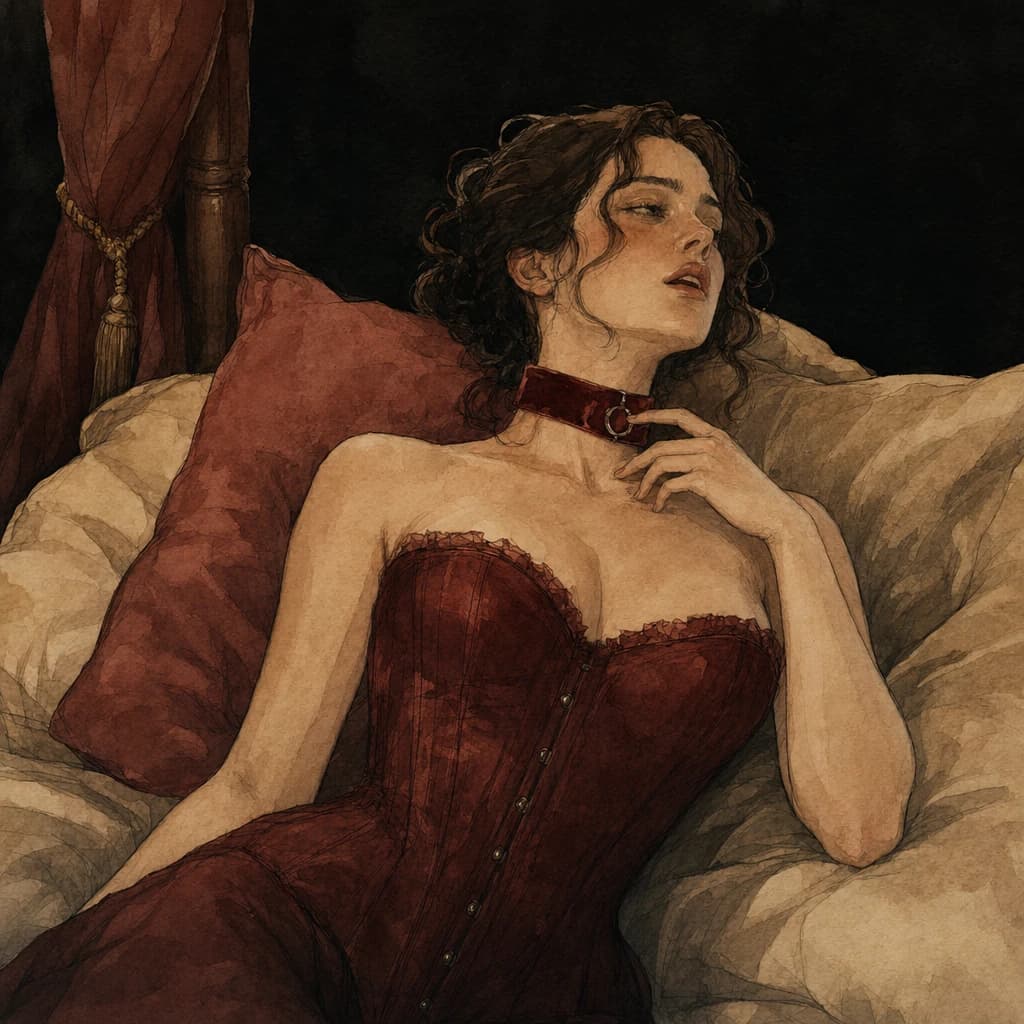
The important part is the claim. Ownership can be sexual, romantic, service-based, symbolic, high protocol, low protocol, occasional, or lived all day. A couple might use a collar and rules during scenes only. Another might keep a day collar on through ordinary life. Another might build a full M/s structure where ownership shapes chores, speech, sex, service, and long-term devotion. Ownership is not automatically total control. It is a negotiated way of making belonging erotic and emotionally real.
In an ownership arrangement, the submissive willingly gives the Dominant some kind of authority or symbolic claim. I don't mean a bit of "Yes, Sir" in bed followed by a full reset when someone needs to argue about the bins. I mean a chosen sense that this part of the submissive's body, service, attention, obedience, pleasure, or identity belongs to the Dominant in a way both people can feel. Far from being coerced, the submissive typically deeply desires that arrangement as emotional, sexual, or even spiritual fulfilment. I've seen submissives fight for it, ache for it, grieve when they haven't got it in their life. That doesn't look like someone being dragged along against their will to me. Recent research on dominance and submission cognitions makes the same point in less romantic language: the same power-exchange content can be wanted and pleasurable or unwanted and intrusive, so the meaning lives in appraisal, context, and consent, not in the keyword itself.
Our own BeMoreKinky app data says something similar in the language of actual choices rather than theory. In collaring, ownership, and symbolic-belonging responses, interest is not just about the fantasy label owned. People are responding to the concrete signs: decorative collars, being told "you belong to me tonight," cuffs clipped to a collar ring, a scent worn because it came from them, a leash indoors where nobody else has to see it. Across broader power-exchange responses, the emotional centre keeps coming back to devotion and visible action: many submissive users strongly agreed that devotion is a primary theme, and that submission should show up in behaviour, not just pretty words. That matters. Ownership is not only I am yours whispered into someone's neck. It is also look, I did the thing; I remembered; I carried you into my day.
I know how this sounds to anyone outside BDSM. Alarm bells, red flags, the lot. But here's what every pearl-clutcher misses: ethical ownership kink is worlds apart from non-consensual control. Sex educator Janet W. Hardy notes that in BDSM, all participants have one another's well-being as the paramount goal, and that caring intent is what differentiates power exchange from abuse. The submissive hands over body, time, habits, embarrassment, arousal, ordinary little choices; the Dominant has to hold all of that without getting drunk on it. That should put a knot in your stomach. If it doesn't, you're not the person to be holding it.
Therapist Jack Morin identified "violating prohibitions" and "searching for power" as two foundations of erotic excitement, and he's right. Breaking the rules and playing with power lights an erotic fire like almost nothing else. No wonder the taboo thrill of being owned or owning someone creates such a charge. It should feel transgressive. That's half the fun.
Common Ownership Dynamics
Ownership kink isn't one-size-fits-all. It never could be, because the whole thing is built on the specific, negotiated dynamic between the people involved. A few labels come up often enough that they're worth naming, although real dynamics rarely stay in their little boxes. They sprawl. They borrow. They contradict themselves. That mess is the point.

-
Master/Mistress and Slave: Say "owned" in a kink space and plenty of people picture this first: Master or Mistress, slave, collar, rules, all of it. And because someone always needs it spelled out: no, that is not a defence of historical slavery. It's a consensual role meaning the person has given broad power over their life to their Master or Mistress. Many M/s couples draw on protocols from the Leather community or other formal traditions. The slave might have rules about speaking only when spoken to during certain times, or performing specific duties as acts of service. The Master/Mistress may control aspects like attire, diet, daily schedule, or sexual release. Some even draw up a slave contract outlining rights and responsibilities, and yes, it's as serious as it sounds. Kink educator Mollena Williams-Haas offers a distinction here that I think about a lot: owning a thing isn't the same as mastering it. Anyone with resources can own a horse, but only a dedicated few truly master the art of riding and caring for that horse. The best in the M/s community strive to be both: they own their partner and constantly hone their mastery of meeting that partner's needs. Ownership without mastery is just entitlement in nicer boots, and entitlement should not be within grabbing distance of a collar.
-
Dominant and Submissive (D/s) Relationships: Some D/s couples hear "24/7" and immediately know it would flatten the fun out of the thing. Their ownership lives in chosen places: a bedroom title, a kneeling rule, asking before coming, a Sunday night ritual, a name that changes the temperature of the room. Then Monday happens and both people go back to being two adults with emails, rent, and one shared kettle. Others live in D/s almost all the time but leave a few things outside the collar, often career, money, family stuff, or health decisions. The Dominant still has real authority, but the couple negotiates which parts of life fall under that umbrella. This is ownership as a sliding scale, and in my experience, this is where most people actually land in practice. Even if the fantasy is 24/7, even if the desire is 24/7, life has a way of insisting on its own terms. What stays constant is the erotic charge both people get from the power imbalance, whether it's full-time or just weekends. I'd argue the dynamic is no less real because it has boundaries. Boundaries are actually what make it real rather than just a fantasy that collapses the first time someone has a bad day at work. Sometimes the symbol is the compromise: a ring, necklace, anklet, scent, or day collar that says this part of me is still under your hand while the rest of life has to be handled like adults.
-
Owner and Pet: Some people eroticise a pet play style of ownership, and it's one of the dynamics I find most fascinating for how it strips things back to something almost primal. In pet play, the roles get literal very quickly: Owner, pet, collar, bowl, paws on the floor if that's the flavour. Puppy, kitten, pony, something stranger; sometimes the animal is simply the part of them that can finally stop negotiating. The appeal, from what I've seen and been told, is feeling a more primal, less human form of submission. Pets don't have to worry about human decisions. The thinking just stops. And the Owner gets to dote on their pet with a blend of affection and authority that can be far more nurturing than the outside world would ever guess from looking at the aesthetics alone. Owner/pet dynamics may be 24/7 or just occasional scenes, and the psychological depth can surprise you. A pet fully internalising that sense of being owned property, just in animal form.
-
Other Ownership Dynamics: Human imagination is gloriously endless, so there are plenty of other variations. Some couples explore Consensual Non-Consent (CNC) within an ownership context, essentially pretending there's no way out, even though consent was given and negotiated well in advance. The submissive may protest or play reluctant while the Dominant "forces" compliance inside a scene built around capture or kidnap fantasy. In longer CNC-flavoured dynamics, the agreed fiction may be that the submissive never agrees at all. They're the captive, the prisoner, indefinitely. It's edge play of the highest order, and it requires a frankly terrifying amount of trust and communication to do well. One recent analysis of CNC treats long-term authority-transfer dynamics as places where ordinary reactive agency may be deliberately paused, which is exactly why trust and attentiveness have to do more work here than fantasy bravado ever can. Other dynamics include "1950s household" style power exchange, where the Dominant is head-of-household and the submissive is the subservient homemaker. There are also Gorean lifestyle practitioners (inspired by the sci-fi "Gor" novels) who follow very formal M/s protocols and use terminology from those books. I'll be honest, the Gorean thing isn't for me. But your kink is not my kink, and the consent and fulfilment of those involved is what matters, not whether I personally find the source material a bit naff.
Daily Life in an Ownership Relationship
This is the part that trips people up. The reality of a 24/7 ownership dynamic is simultaneously more mundane and more intimate than most people expect. It's Tuesday morning, and someone is kneeling with a cup of coffee.
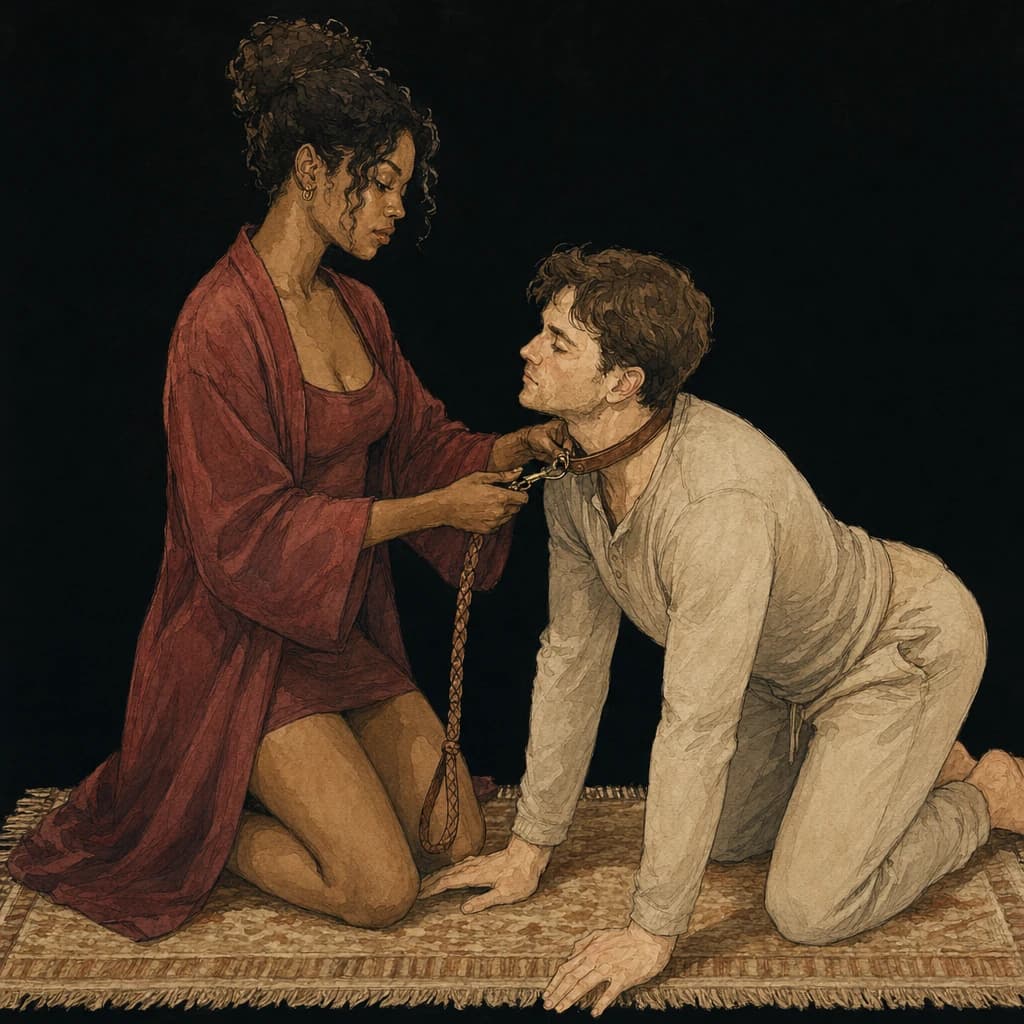
Picture that morning. Maybe they're up before the alarm, kneeling by the bed and trying not to yawn. Maybe the Dominant reaches for the collar before reaching for their phone. And there it is. That quiet moment. The Dominant seeing their partner's devoted posture. The collar settles, and the owned one gets that private drop in the chest: there, mine, still. Try explaining that over brunch to people who think kink begins and ends with handcuffs.
Some days come with protocol: chores, service, reminders, filthy instructions, instructions so unsexy they become funny. No two households do it the same way. One household might have the submissive cook exactly the way the Dominant likes it, clean in collar and cuffs when the curtains are closed, or ask before making any non-routine decision. Another owner might leave a checklist: wear this, finish that, be ready for me at this time, no touching yourself unless I say. That is why the "boring" task often isn't boring at all; philosophical work on BDSM scenes argues that a chosen obstacle can turn an ordinary action into meaningful power exchange, because the task is done inside an agreed role and structure. In return, the Dominant actively leads and nurtures the structure. They inspect, they reward, they correct when needed. And a loving owner will praise good behaviour lavishly. Those words "good girl, I'm proud of you" can sustain a submissive for days. I've seen one sentence do more for someone than a dozen expensive date nights.
If a rule is broken, the consequence should already be known: spanking, lost privilege, lines, whatever belongs to that dynamic. Not random temper. A known consequence. And for many submissives, structure is safety. I think people who've never craved that kind of framework struggle to understand it, but the relief on a submissive's face when everything has clear expectations and clear consequences? You can't fake that.
The charge gets into the boring bits. If a submissive has to ask "May I please orgasm today?" and the answer is sometimes, calmly, "No," the whole day tilts. You can feel the power exchange humming under lunch, emails, washing up, everything. Protocol at mealtimes, maybe the submissive eating at the Dominant's feet, or waiting until the Dominant takes the first bite. A discreet day collar worn to work, so the submissive smiles secretly knowing who owns them even when they're apart. A text command during lunch that makes their stomach flip. These aren't quirks. They're the relationship's heartbeat.
This is why collars and other ownership symbols can hit so hard. To an outsider, a collar is a strip of leather, a necklace, a bit of steel. To the person wearing it, it may be a vow with a clasp. BeMoreKinky's symbolic-belonging data puts decorative collars, soft collars, collar D-rings, scent marking, symbolic jewellery, and indoor leash play in the same emotional neighbourhood: visible or private proof that the dynamic has a body. The submissive side often shows especially strong interest in wearing the thing, walking on the leash, carrying the scent. That does not mean every owner has to make a production of marking someone. It means the action itself can be the devotion. A collar fastened before bed. Perfume on a wrist before work. A ring touched under the table. A leash clipped on for three quiet minutes in the hallway, not because anyone needs theatrical humiliation, but because the nervous system understands: I belong. They remembered.
But here's what people on the outside consistently fail to grasp: daily life in an ownership dynamic isn't all rules and protocol. It's also about an emotional closeness that, frankly, a lot of vanilla relationships could learn from. One person in a full-time power-exchange dynamic explained that "I enjoy the intimacy of giving that level of trust and power to someone and I like not having to worry about making decisions." And from the Dominant side, being an owner isn't about selfishness. It's about service too, in its own way. A qualitative study of people with Dominant identities found control and power exchange sitting alongside connection, fulfilment, consent, safety, learning, and caregiving; that is a much better picture of good ownership than the cartoon tyrant people imagine. As one Dominant put it: "I strive to be worthy of the faith my slave places in me every single day." I love that. Because good ownership looks like someone who wakes up every day knowing they have to earn the trust that's been placed in them, not some bloke barking orders from a sofa.
The sexual dimension is woven throughout, naturally. In many ownership dynamics, the Dominant dictates sexual encounters: when, how, sometimes even the submissive's responses. Some ownership couples incorporate objectification, with the sub called "my toy," placed in positions where they serve as furniture for the Dominant's use. I've heard of a submissive kneeling as a human footstool while the Dominant read a book. Nothing "happened," technically. And yet the whole thing was charged with service and submission: weight, stillness, usefulness, being chosen for a purpose. If you know that pull, you know it immediately.
And of course, real life still happens. Jobs, stress, grocery shopping, the boiler breaking, whatever. These things don't disappear because you call your partner Master or slave. For many ownership couples, the key is integration, finding ways to honour the claim even amid the utterly ordinary. I've read a lot of books on this dynamic, and the one that nailed this most plainly is Living M/s by Dan and Dawn Williams, a married couple who'd been in a 24/7 Master/slave relationship for over a decade when they wrote it. Their framing has stayed with me: "BDSM is how we play; M/s is how we live." That single line cuts through every romanticised version of the thing. The cat still needs feeding, someone still does the litter box, one of them took over the grocery runs when the other was laid off, and through all of it, the structure never stopped being who they were. When life gets ugly, the structure can become something to grab. A stressed submissive may not need a motivational speech; they may need the order: bath, food, bed, phone away. He told me to rest, so I rest can sound bizarre from outside and merciful from inside. I've seen D/s relationships hold people together through periods that would have destroyed something more conventional, purely because the framework was there and both people trusted it.
Maintaining Consent and Safety
Consent in 24/7 ownership is not a one-and-done handshake. The first yes may be broad, but the later yeses matter just as much: the check-in after a rough week, the out-of-role conversation in the kitchen, the moment someone says, "Actually, that rule is starting to mess with me." What thrilled you six months ago can start to grate or choke. You need a way to say that without detonating the whole dynamic.
Since an ownership dynamic may not simply switch off at 10pm, couples usually need a clean route out of role: collar off, a particular phrase, a scheduled check-in, whatever works. There still has to be an emergency brake. The safety frameworks underpinning consensual BDSM apply with extra weight when the dynamic is ongoing rather than scene-by-scene. If someone tells you that real ownership means no safeword, no out, no limits? Walk away. That is abuse wearing a leather jacket.
The Dominant carries a huge responsibility in ownership arrangements. They have to notice the little changes: the flat voice, the flinch, the over-eager "I'm fine," the subdrop creeping in sideways. The submissive's welfare is not a side quest. It is the floorboards. If it cracks, none of the rest matters.
Ownership kink is, when you strip away the shock value and the misconceptions, about voluntarily giving meaning to being claimed. Obeying another's will to discover your own kind of freedom. Building the sort of trust that lets you explore desires you might not even have words for yet.
It's not for everyone (nothing worth doing ever is), and it requires more communication and more care than most vanilla relationships will ever demand of you. It will frighten you, sometimes. You may meet parts of yourself you were quite comfortable pretending not to have.
But for those who feel it? For those who've looked at their partner and thought I want to belong to you entirely, or I want you to be mine in every possible way? There's nothing else like it. And you don't need anyone's permission to want it, except each other's.