BDSM Rigger and Rigger Kink: Roles, Rope, Consent, and Safety
The first length of jute I bought shed little fibres all over my black jeans, and my first thought was, well, that's inconveniently hot. Not Pinterest trouble. In the way where your brain goes quiet and your pulse doesn't. I didn't know the word "rigger" then. I just knew that something about rope, the weight of it, the texture, the way it could transform the space between two people into something electric and deliberate, had got under my skin and wasn't leaving.
In BDSM, a rigger is the person who ties or restrains a partner with rope (or sometimes leather, ribbon, anything that binds). And, I'll tell you, a good one is hard to find. Their partner, the rope bunny or rope bottom, is the one being tied. The kink is the charge around being that rope person: the craft, the control, the beauty, the care. When the two people are tuned in, it can feel almost indecently intimate.
Being a rigger isn't the tired cliche of the brooding Dom lashing a helpless waif to a bedpost. You need a partner who has actually said yes, hands that know what they are doing, and enough patience to slow down before the rope gets clever. Riggers are not one kind of person. Curiosity helps. So does being the kind of person who notices a cold hand before your bottom has to mention it.
What Is a BDSM Rigger or Rigger Kink?
A BDSM rigger is a person who enjoys tying up others as a form of bondage play. A rigger kink means the tying role itself has erotic, sensual, artistic, or emotional charge for you. The word borrows from ship rigging (the handling of ropes and sails). You learn ropework, yes, but you also learn pressure, pacing, vulnerability, and the kind of touch rope makes possible.
Most riggers work primarily with rope, though some experiment with straps, chains, or other materials that can safely bind. Some approach rope bondage as art, including those stunning Shibari photographs you've likely seen. Other people use rope for power play, for sex, or for the weird floating endorphin rush a good tie can bring. You do not have to decide your whole relationship to rope on day one.
Being a rigger is a role, not an identity you're stuck with. You might be someone's equal in every other hour of the day and step into the rope top role for a scene. Many people switch roles depending on the day or the partner. And the role isn't inherently sexual; plenty of rope scenes are non-sexual, focused on aesthetics and connection rather than anything explicitly erotic. Research on Dominant BDSM participants finds the same useful split: some people experience a role as core identity, while others treat it as chosen practice.
Aside from the physical tying, a good rigger is part engineer, part caretaker. You plan scenes, select the right rope and tie for the situation, and then you do the work. You might bind your partner's wrists, weave a chest harness, or immobilise their body in something more elaborate like a predicament tie. Throughout all of this, you're reading your partner: checking their comfort, watching their reactions, maintaining their safety.
A rigger can tie themselves, too. Self-tying is a way to practise knots or experience the rope's embrace solo. I've spent more evenings than I'd care to admit practising ties on my own legs while watching television. Just be aware that self-bondage has its own safety requirements: always have a way to get yourself free.
Each wrap and cinch is touch, and it's communication too. Every tensioning says I've got you without words. When it lands, the trust is almost physical.
Rigger vs. Rope Top vs. Rope Bunny
Rope people argue labels because the same word can mean role, skill set, or bedroom mood depending on who says it. For a rope scene, these are the useful ones:
-
Rigger: The person tying the ropes. The term implies skill or genuine passion for rope bondage. Sometimes also called a rope rigger or bondage rigger.
-
Rope Top: Simply the active partner doing the tying. Every rigger is a rope top, but not every rope top would claim the title rigger; some just casually tie someone without any particular rope obsession. Think of "rigger" as a rope top who's into the craft.
-
Dominant (Dom/Domme): A power role, not a specific activity list. A Dominant may run the psychological and erotic frame of a D/s relationship or scene. A rigger often looks dominant while tying because they are giving instructions and controlling the body in front of them. But a rigger is not always a Dominant in the overall relationship. You might be the submissive partner ordinarily but top with rope because you have the skill, tying at your partner's request. Conversely, a Dominant could let their submissive tie them up as a role reversal. Many riggers are Dominants, but it's not a requirement.
-
Rope Bunny / Rope Bottom: The person being tied. "Rope bunny" is slang for someone who loves being in rope, often eagerly. The term has nothing to do with gender; anyone can be a rope bunny.
-
Switch: A person who enjoys both topping and bottoming. In rope, many people switch. Trying both sides can make you better at each.
A bottom might be directing the entire scene from within the ropes, specifying exactly how they want to be tied, essentially topping from the bottom. Labels are tools, not cages. Traditionally, riggers were seen as the Dom and rope bunnies as the sub, but today the dynamic is based on negotiation and what the people involved actually want.
A note on pronouns: old BDSM writing often defaults to he for Dominant and she for submissive. Reality is far more interesting than that. Any gender can be any role. When I say "the rigger" and "the rope bottom," assume whatever configuration suits your situation.
Why People Enjoy Rigging
-
The power and the responsibility. There's a real erotic charge in having someone completely at your mercy, when they've consented to it. You control how your partner can move. That power, and the trust under it, creates a tension you don't get anywhere else. Your rope bunny might resist, struggle, test the binds, and every bit of that is part of the scene you've built together. Seeing a partner in ropes, watching their expression shift as they surrender into it, is something that stays with you. And the weight of being the person they chose to trust with that vulnerability? That's its own kind of high.
-
Creativity and artistry. Rope bondage is often called an art form, and honestly, it is one. You're creating live sculpture. Every wrap and weave is deliberate. Red ropes against skin, the symmetry of a well-made chest harness, a body held in a position you designed; there's a deep, tactile satisfaction in it. If you've ever lost yourself in any hands-on craft, rigging scratches that same itch. Except your material reacts, gasps, and breathes.
-
Connection and trust. This is the one riggers talk about most, in my experience. Someone is letting you bind them, make them unable to move. Being trusted that way can put a strange closeness in the room. Mid-tie, you're near enough to hear breathing change. The room can get very small: rope, skin, floor, and the next inch of line. A lot of riggers describe a kind of flow: calm, focused, almost blank except for the rope and the person in it. You might even experience a top's equivalent of subspace: that zone where you and your partner are wordlessly locked in together.
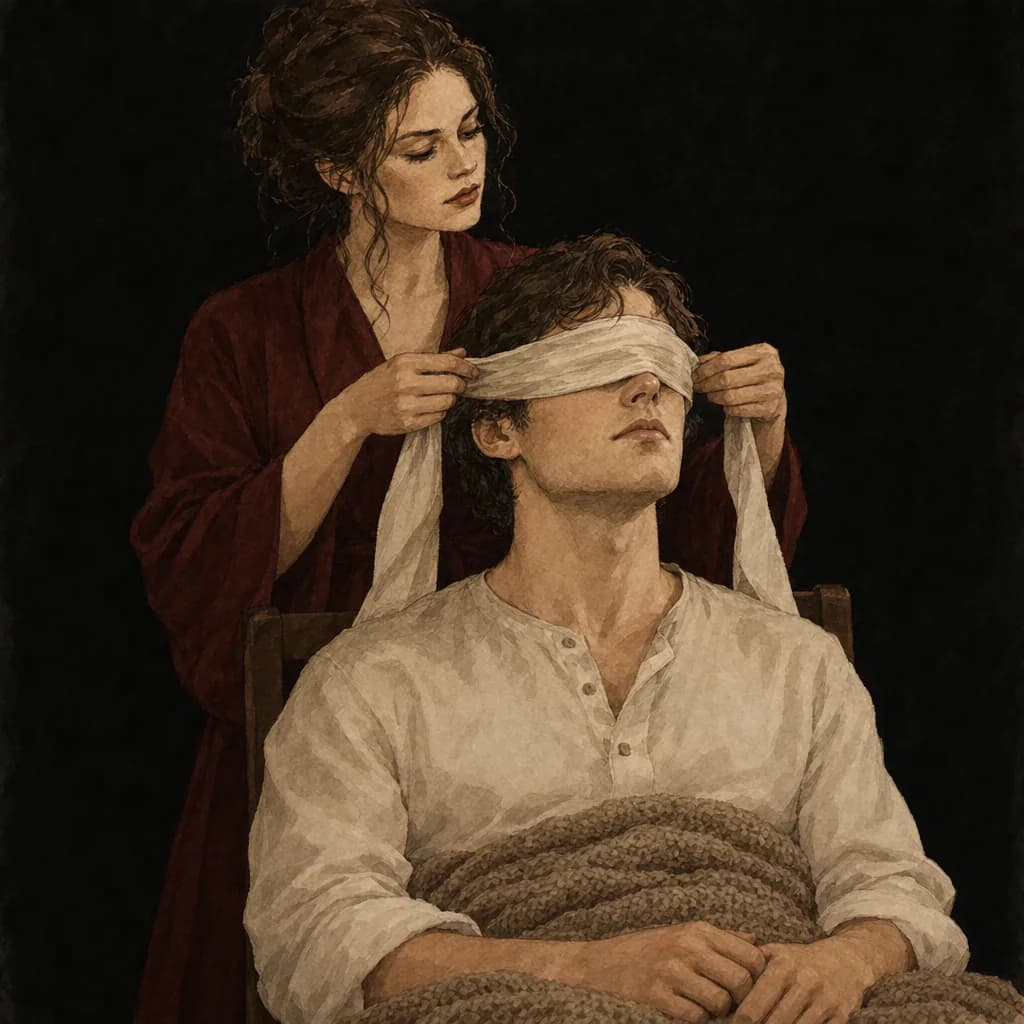
A blindfold can deepen the trust and sensory focus rope already builds.
On the bottom side, rope can narrow attention into sensation, breath, and release. The freedom the bottom finds in surrender is only possible because you've made the space for it. Being the person who holds that? I can't overstate it. When I read The New Bottoming Book by Dossie Easton and Janet Hardy, what struck me was how they describe the interior state of being tied: "receptivity might involve being acted upon while having no actions whatsoever to perform yourself, as in a bondage scene: this allows an intense focus, free of distraction... The selflessness here involves giving yourself over to another so completely that you effectively leave your self behind." Reading that as a rigger clarified something I'd felt but couldn't name: the ropes don't just hold a body, they create a container for that particular kind of leaving. You are the person who makes that possible.
-
Sensual and physical pleasure. Rope sliding through your hands, the sound of fibres brushing skin, the way a body looks in binds you've made. Rigging involves a lot of physical closeness: positioning your partner, lifting limbs, handling them to get the rope where it needs to be. Sometimes it's just touch: a thigh lifted, a hip turned, a knot tightened, that little breath after.
-
Emotional release and focus. If your brain runs hot, rope can quiet it. It requires concentration, but it's a pleasurable kind. When you're rigging, everything else, the inbox, the to-do list, the general background noise of being alive, fades. It's you, your partner, the rope. Right here, right now. On the other side of it, rope works as an emotional outlet too. If you have a sadistic streak, rope lets you play with power safely; you can be the villain, the captor, whatever your particular flavour of wicked calls for, all within boundaries you've both agreed to. More nurturing riggers might tie their partner snugly and then cradle them. Rope can be soft or hardcore, playful or strict. And seeing your bottom float in subspace, or watching them come back to themselves afterwards with that particular softness in their eyes? That's hard to get anywhere else.
Is Rigger Kink Always Sexual?
Not always. Rope can be erotic, obviously, but it can also be aesthetic, meditative, performative, affectionate, grounding, or some messy mix of all of those. Some self-tie because the pressure helps them land back in their body. Some couples do a rope scene, untie, drink water, and never make it genital. Not all rigger BDSM participants are interested in the sexual side, and some experience rope as artistic, spiritual, or performance work instead.
In one international survey of BDSM practitioners, enjoyment and fun showed up more often than sex as a reason for participating, and many people reported BDSM play with friends, BDSM-only partners, strangers, or alone. Sex can be part of rope. It does not have to be the proof that the scene "counts."
Ask early: Are we treating rope as foreplay, as its own scene, as art, as power exchange, or as something quiet and non-sexual? If one person expects sensual shibari and the other expects sex afterward, the mismatch is already in the room. Non-sexual rope still needs consent, aftercare, and safety. No sex does not mean no impact.
Is a Rigger Always a Dominant or Always Male?
Let's be direct about this, because the assumptions are persistent and they're wrong.
-
Rigger does not equal Dominant. Yes, a rigger is typically topping during the act of tying. But outside of that specific activity, the rigger might not hold the power at all. Many couples enjoy rope with very light D/s dynamics or none whatsoever; it's about mutual exploration, not about a hierarchy. It's entirely possible for a generally submissive person to take the rope top role because they have the skills, effectively becoming a service top, topping as a service to their partner's desire. There are cases of a Dominant requesting their submissive to tie them, perhaps as a twist on power exchange or to show off the sub's skill. The FetLife Kinktionary notes that while historically riggers were seen as dominants, today the dynamic is based on negotiation; some riggers are actually the submissive of the person they're tying. Agree on the power dynamic before the rope comes out. Good tying is technique plus care, not a permanent need to be in charge.
-
Riggers can be any gender. In the traditional imagery, it's a large man tying a petite woman. In practice, look around any rope jam or workshop and you'll find women who tie, male bottoms who love being bound, non-binary people on both sides of the rope, and every other combination. Some of the most skilled riggers I've encountered are women. If you tie, you're a rigger. Full stop. There's no gender prerequisite.
-
Dominant women rigging is absolutely a thing. A Dominant woman tying her male submissive flips the tired damsel trope on its head, and it's brilliant. Men being rope bunnies doesn't diminish them in the slightest; many find enormous relief in surrendering to rope. And men tie men, women tie women. All combinations exist in the rope community. The thing that connects people in rope isn't gender. It's the love of rope itself.
-
Dominant versus Top: a subtle but important distinction. Dominant is a psychological role. Top is a physical one. A rigger is definitely the Top during the tying. Whether they're the Dominant is something you negotiate. Two switches might practise rope together without any power exchange at all, just equals trading off, tying each other up for the pleasure of it. Consent and comfort trump any expected script. In BDSM, we get to write our own.
BeMoreKinky's preference data has the same feel: for a no-suspension karada/body-harness item, interest in tying it sat almost level with interest in wearing it. Tying drew 62.1% yes and 83.9% yes or maybe; wearing drew 63.6% yes and 83.0% yes or maybe. Rope interest is not a neat one-way funnel from Dom to sub. Plenty of people are curious about both ends of the line.
What Beginners Should Learn Before Tying a Partner
There's a learning curve, and ignoring it is how people get hurt. Before you put a single loop on a human being, learn the fundamentals.
1. Do your research. Read before you tie a person. Rope looks obvious until it isn't. Start with a proper beginner's guide: Two Knotty Boys Showing You the Ropes is solid, and there are reputable online resources like TheDuchy. If you can, learn around other rope people too. Jones's work is a useful reminder that rope has habits, roles, and norms around it, not just private technique. Understand why certain ties are safe and others aren't. Learn what a single column tie does, then learn a double column tie for two limbs together. The words are less important than knowing what each structure does under tension.
2. Master communication and consent first. Talk before rope touches skin. Ask what kind of scene they want and what would make them wish they'd said no. Ask whether the nerves are fun nerves or please slow down nerves. Ask about injuries, medical stuff, and triggers before rope turns the conversation into a problem. Negotiate boundaries and a safe word. Ask specific questions: Is it okay if I tie your legs apart? Any off-limits body parts? What kind of touch do you want while tied? Get the awkward details out early. If you're new, say so plainly. You're not performing a suspension on day one. Keep asking as the scene shifts, because a yes can get outdated quickly. Stop means rope off, no debate, no sulking.
3. Know the risky spots. Learn the spots rope should not bully. Rope can go from intimate to dangerous when it sits on the wrong spot for too long. Study the nerve and circulation risks every rigger should memorise: where the major nerves and arteries sit, the warning signs of compromised blood flow, and which zones are safer.
4. Practise knots off-body. Tie a pillow, a rolled towel, your own ankle, anything that will sit still. Let your hands learn the route before there is a real person breathing in front of you. You want to know how to tie a sturdy knot that doesn't cinch tighter under tension; avoid simple slip knots or granny knots that can turn into a noose. Our guide to the essential Shibari knots and ties walks through the beginner-friendly knots and ties step by step. Drill them until you can talk while tying. In a scene, that frees your eyes for your partner.
5. Set up before you tie. Run the rope through your hands first: frays, stiff patches, weird stretch.

Settling your partner is part of setting up a rope scene.
Put safety shears within reach, not "somewhere in the room"; EMT shears are blunt-tipped and cut rope fast, and keeping them close enough that one hand can find them is non-negotiable. Jammed knot? Panicked partner? Seconds count. Put padding and first aid close by, even if that just means a blanket and a couple of pillows. If a ceiling hook, door-frame bar, or other hardpoint is involved, check the load rating before you trust it with a body. And start on the ground.
6. Start slow and simple. Early scenes should feel almost too easy on paper. Tie the wrists. Attach them to something solid. Or build a chest harness while your partner sits or lies down. Wrists and ankles, with slack, is already a scene.
A simple wrist tie is plenty for a first rope scene. Then you can watch your partner instead of fighting a pattern you only half remember. A simple tie can still hit hard. Save the elaborate stuff for later.
7. Plan for the unexpected. Your partner might have an unexpected moment of panic. They might laugh uncontrollably from nerves. Rope that behaved on a pillow may turn annoying on a real body. Be ready to pause, loosen, retie, or call the whole thing off. If something isn't working, pause and fix it; don't push on with a tie that isn't right for the sake of finishing. There's no finish line except both of you being okay. Establish the "traffic light" system: yellow for "I'm approaching a limit" and red for "stop now." If your partner can't speak (gagged or deep in headspace), have a non-verbal safe signal, such as a ball they can drop, three quick taps, whatever works. Encourage them from the outset that communicating discomfort isn't ruining the mood; it's part of the play.
Jay Wiseman (author of SM 101 and The Erotic Bondage Handbook) advises that you should always slip a finger under each wrap to ensure it's not too tight, and always have those safety shears ready.
Now pick rope you will not hate using. Our guide to choosing the right rope covers cotton, hemp, jute, and synthetics, plus length, thickness, and care, in depth.
Safety Rules Every Rigger Needs to Follow
If you skim everything else, slow down here. The gap between a hot scene and a trip to A&E is sometimes one ignored warning sign.
Never leave a bound person alone. If you tie someone up, you stay with them. Not to use the bathroom; untie them first. They are helpless and depending on you. Things go wrong quickly, so stay close enough to act.
Use a safe word and/or safe signal. Establish a clear way for your partner to say "stop," then honour it immediately: stop and untie, no debate. Check in out loud while you tie, especially while your hands are still new.
Watch for signs of distress. Check your partner's fingers and toes regularly. Sharp, electric, or radiating pain is urgent. Stop and fix it now. A pretty arm tie is never worth a wrist drop, as a 2023 case study of bondage-related nerve injury makes plain.
No rope around the neck unless you are very advanced. Neck bondage is extremely risky. The carotid arteries are right there; pressure can cause fainting or stroke. A loose loop can tighten when the person shifts or another rope pulls. Many experienced riggers refuse neck rope entirely. Save it for much later, if ever, and only under expert guidance.
Avoid tying directly over joints and nerve-heavy areas. Don't wrap rope hard over knees, elbows, or shoulders; these areas injure easily under strain. Aim just above or below joints. Nerve clusters, including inner upper arms (brachial plexus), inside of wrists, back of the knees, and inner thighs, should have minimal sustained pressure. Use wider wraps near those areas to distribute force. A thin single rope digging into the upper arm is bad; a wider band of rope is somewhat safer. If your partner reports sharp, zinging pain, that's likely nerve pain; stop.
Ensure knots won't tighten under strain. Before you finish a tie, ask the ugly question: what happens if they pull hard? If the answer is "it gets tighter," don't use it. No sliding nooses on limbs. Bondage techniques are designed so ropes stay at the tension you set. Test your ties by pulling on them before your partner is in a stressed position.
Keep a cutting tool within reach. EMT shears on the floor next to you, in a pocket, or in a holster, at all times. Not in another room. Not across the dungeon. They cut through rope fast and the blunted tip slides under ropes without piercing skin. Cutting a nice piece of hemp is a fine trade for not injuring your partner.
Don't push past known limits or pain. Sharp, burning, or panic-inducing pain is bad pain; the ache of a taut limb or tight squeeze may be fine. If your partner flags something that doesn't feel right, address it immediately. If you notice a numb hand or strained shoulder before your partner does, call it yourself; the bottom may be deep in headspace. Never let your ego override your partner's wellbeing.
Mind the duration. Arms tied behind the back strain shoulders; hands can go numb after twenty minutes. Rope tightens as people move or sweat, so check in and retie or loosen for longer sessions.
Gags require a backup signal. A bound and gagged person can't use safewords. Use a non-verbal alternative: a ball they drop, three taps, or a raised hand. Skip gags in rope scenes until you're confident with restraint alone.
Avoid suspension early on. Full suspension is hazardous unless you truly know what you're doing; as a beginner, keep things grounded. Our guide explains why suspension is advanced-only play.
Have aftercare ready. Keep water and a snack nearby. When the rope comes off, have your partner sit before they stand; dizziness and sleepy limbs are easy to miss. See BDSM aftercare for the full picture, including subdrop.
Follow the boring safety rules and most scenes end with nothing worse than rope marks. We operate under RACK: risk-aware consensual kink; risk does not disappear because everyone consented. "If in doubt, take it out." Untie first, talk after.